A family saga carried across generations and continents.
A five-book literary series about migration, memory, architecture, inheritance, and the places that continue shaping us long after we leave them.
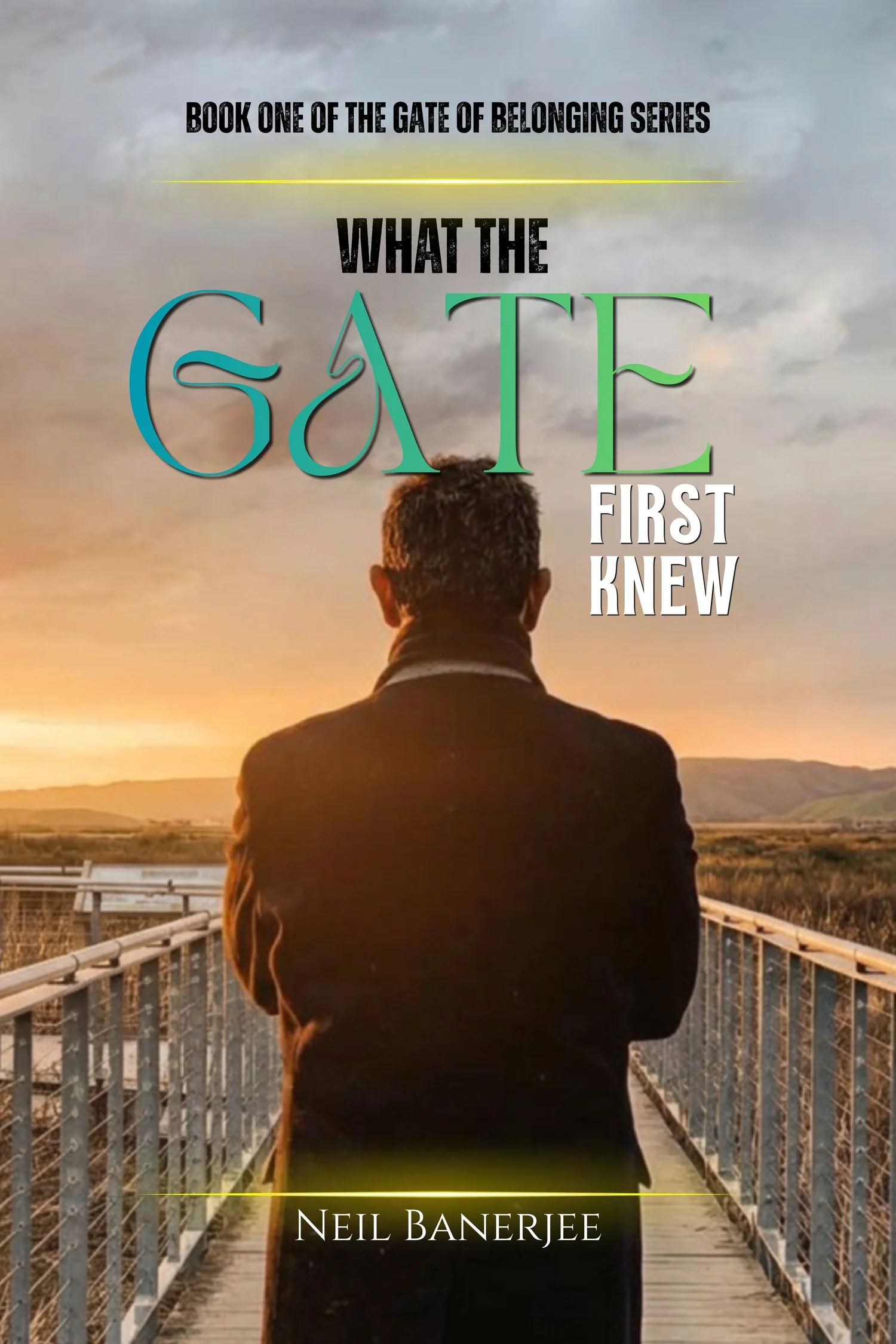
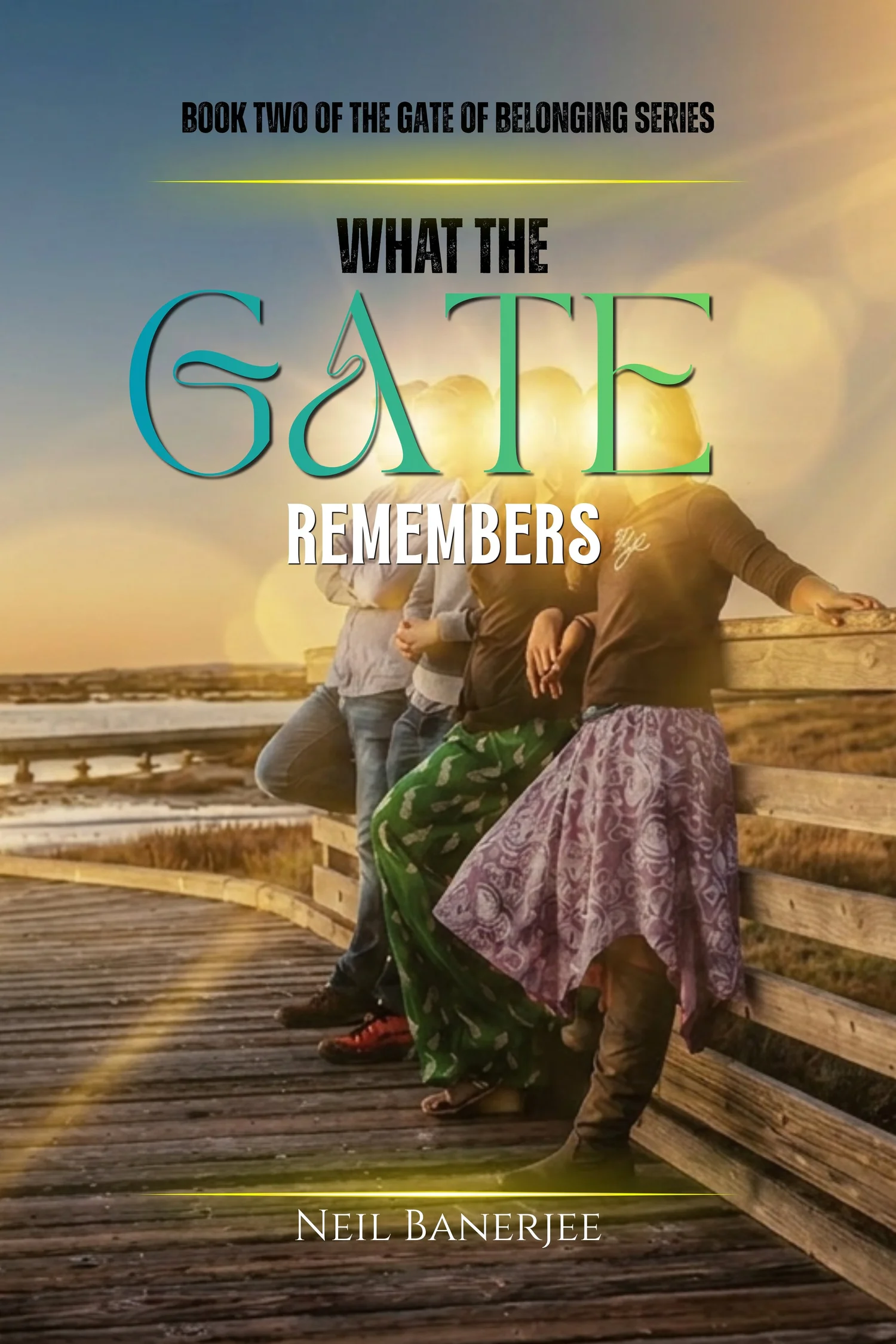
Two doors into the same family story.
Begin with departure, then follow what the next generation inherits. The first two novels of The Gate of Belonging are available worldwide in paperback and eBook.
What the Gate First Knew
Some inheritances arrive as objects. The most important ones arrive as unfinished sentences.
What the Gate Remembers
Some inheritances aren't objects. They're unfinished conversations, passed down until someone finally answers them.
What the Gate First Knew
A novel by Neil Banerjee
Some inheritances arrive as objects. The most important ones arrive as unfinished sentences.
Abir Das grows up behind a green gate in Kolkata, in a house that smells of mustard oil and old paper, raised by a physics professor father and a mother whose kitchen holds its own quiet, undeclared intelligence.
At twenty-three, he leaves for Germany, certain he is only leaving temporarily. He isn't.
In Berlin, he meets Harleen Kaur—a Punjabi architect from Delhi. What begins as professional rivalry becomes a marriage that refuses to choose between two countries, two languages, and two very different ideas of what home is supposed to mean.
Together they build a life across Berlin and Boston: an architecture practice, two children, and a home that never quite settles into just one place.
What the Gate First Knew is a novel about distance—the distance between countries, generations, and the person you were raised to be and the person you become by leaving.
Worldwide availability Choose a bookseller Amazon, Barnes & Noble, Bookshop.org, India, UK and more
Buy What the Gate First Knew
Available in paperback and eBook through major retailers, independent bookstores, marketplaces, and international booksellers.
Purchase
Paperback and eBook editions




Discover & Compare
Reader reviews and worldwide price comparisonWhat the Gate First Knew — Official Book Trailer
Enter the opening chapter of The Gate of Belonging, a five-book literary family saga by Neil Banerjee. What the Gate First Knew follows Abir Das from the green gate of his Kolkata childhood into a life shaped across Berlin and Boston by migration, architecture, family, memory, love, and the continuing search for home.
- Featured novel
- What the Gate First Knew
- Series
- The Gate of Belonging · Book 1
- Author
- Neil Banerjee
- Core themes
- Belonging · Migration · Family · Memory · Architecture
What the Gate Remembers
A novel by Neil Banerjee
Some inheritances aren't objects. They're unfinished conversations, passed down until someone finally answers them.
Twenty-five years after Abir and Harleen built a life together across Berlin and Boston, their children have grown into their own complicated inheritances.
Arin has spent his life fluent in a particular arithmetic: which grandmother to call for recipes, which language to answer the phone in, and how to be Bengali, Punjabi, and entirely American at once.
Mira, younger and more visual, has become an architect in her own right, discovering that the family's obsession with what a building remembers is not something she inherited by accident.
When a structural crack threatens the family home in Kolkata, three generations are pulled back to the house that started it all.
What the Gate Remembers is a novel about inheritance as an active, ongoing negotiation—not a single gift handed down once, but a conversation between generations that never quite finishes.
Worldwide availability Choose a bookseller Amazon, Barnes & Noble, Bookshop.org, India, UK and more
Buy What the Gate Remembers
Available in paperback and eBook through major retailers, independent bookstores, marketplaces, and international booksellers.
Purchase
Paperback and eBook editionsDiscover & Compare
Reader reviews and worldwide price comparisonWhat the Gate Remembers — Official Book Trailer
The second novel of The Gate of Belonging turns to the generation that inherited the leaving. What the Gate Remembers follows Arin and Mira through Copenhagen, Delhi, and the house behind the gate, as unfinished conversations and inherited places draw a family back toward where it began.
- Featured novel
- What the Gate Remembers
- Series
- The Gate of Belonging · Book 2
- Author
- Neil Banerjee
- Core themes
- Inheritance · Memory · Identity · Return · Family
What Readers Are Saying
Every reader walks through the gate carrying a different story. These are a few of the conversations the books have already begun.
What the Gate First Knew
A Gentle Story That Stays With You
“A heartfelt and meaningful read. The story unfolds in a quiet but powerful way, with themes of belonging, hope, and finding your place.”
Poetic and Eloquent
“The author wrote this story so eloquently, it almost presents as poetic. Every detail made the places feel vivid and close.”
A Quietly Profound Family Saga
“A quietly profound family saga spanning continents. Abir’s immigrant journey, marriage, and fatherhood unfold with tender restraint.”
A Family Saga That Settles Deep
“The prose is luminous, the grief raw and real. I found myself moved by the small moments: a phone call, a green gate, a half-finished sentence.”
A Love Letter Across Continents
“That green gate became a character in itself. If you’ve ever loved someone from a distance or built a life between cultures, this one will linger.”
Home, Memory, and Belonging
“A deeply moving exploration of family, migration, love, and identity—a reminder that home is also the people and memories we carry with us.”
What the Gate Remembers
Quiet, Haunting Story of Memory and Belonging
“A quietly powerful novel that works on the level of memory and emotion—a meditation on the houses, thresholds, and communities that shape who we are.”
Beautifully Written Across Continents
“Beautifully written, crossing continents and time frames while weaving a family story. The characters were well built, the transitions clear, and the story engaging.”
A Beautiful Reflection on Family and Belonging
“The green gate and notebook provide a lovely emotional thread, giving the sense that memories and unfinished conversations can linger across generations.”
The Stories We Inherit
“The recurring notebook and family home give the novel a wonderfully intimate feeling, almost as if the house itself is keeping secrets.”
Everything Built, Nothing Given
“Those Sunday phone calls feel ordinary at first, but you can feel how much history and love sits underneath the simple questions.”
A Moving Family Saga
“A beautifully layered novel about family, identity, and the invisible threads connecting generations—rich in emotion without becoming sentimental.”
The books on Goodreads
Current Goodreads ratings and review activity for Neil Banerjee’s published novels.


Selected excerpts from reviews published on Amazon. Excerpts have been shortened for clarity and length. Reviews reflect the individual opinions of their authors.
Why I Started The Gate of Belonging Series
What the Gate First Knew
My first flight took me from Chennai to Detroit—a single leap that felt, at the time, like it was measured in more than just miles. I was born and raised in India, and nothing in that upbringing had prepared me for how strange and total the recalibration would be: a new country doesn't hand you belonging, you have to build it, badly at first, out of small daily transactions you're too proud to admit you're improvising.
Belgium came next, in 1999, and it was there that our son was born in 2001—which meant that before I had fully worked out what “home” meant for myself, I was already responsible for what it would mean for someone else. We moved to America as a young family in October 2004. Less than two years later, our daughter was born here, an American from her first breath in a family that had, by then, already been rearranged by three countries.
That is the actual seed of this book—not the plot, not the characters, not the Das family or their green iron gate, all of which are invented. But the arithmetic underneath it is not: a marriage and a family assembled across borders, children who inherit a version of “home” their parents are still improvising in real time.
What the Gate Remembers
My son was born in Belgium in 2001. My daughter was born in America, less than two years after we arrived as a young family in October 2004. Neither of them chose a country to leave. They were simply born into the middle of one—a family already rearranged by three of them.
I did not understand, when I was the one leaving, what it would look like from the other direction. Leaving is a decision you make once, then spend years discovering what it actually costs. But growing up inside someone else's decision is different—you do not get the leaving, only what comes after it.
I have come to think inheritance is not a single object handed down once. It is closer to an ongoing conversation, one generation leaving a sentence unfinished for the next one to pick up.
More to come
Three more novels in the series are underway, carrying the Das-Kaur family—and the gate itself—further across generations and continents.

Enter the world of the Gate.
The books carry a family across countries and generations. These reader paths open the people, relationships, language, remembered lines, and questions behind that journey.
Meet the Characters
Relationship Architecture
The relationships in the series are not static labels. Each carries its own habits, places, objects, and unfinished conversations.
Abir ↔ Harleen
Marriage, creative partnership, migration, architecture, and the long work of building a home without choosing only one inheritance.
Das & Kaur · Berlin · Boston · TeaAniruddha → Abir
A father teaches through questions, books, silence, and small objects that become legacies only years later.
Atlas · Study · Notebook · ReturnAparna → Abir
A mother anchors the family through food, attention, practical care, letters, and the quiet discipline of waiting.
Kitchen · Hibiscus · Sunday callsAbir & Harleen → Arin
Arin inherits a family already spread across countries and learns to translate belonging between generations.
Language · Memory · Green gateAbir & Harleen → Mira
Mira inherits architecture not simply as a profession, but as a way of asking what should remain and who gets to decide.
Drawings · Buildings · CopenhagenArin ↔ Mira
Brother and sister inherit the same family differently: one through language and memory, the other through image, space, and design.
Siblinghood · Different answersWords from the Gate
A few lines from the novels — the full, searchable collection lives on its own page.
A door is the first sentence a house speaks.Neil Banerjee, What the Gate First Knew
Distance measures miles. Return measures love.Neil Banerjee, What the Gate Remembers
A gate remembers every hand that opens it.Neil Banerjee, What the Gate Remembers
The Englishes of the Gate
The Gate of Belonging follows a family that lives across three worlds — India, Europe, and the United States — and its English carries all three. Readers may notice that the prose never settles into a single national English. That is by design.
An American baseline. The narration’s spine is American — center, color, apartment, toward — the English of the family’s adult life in Boston, and the default voice of the books.
British as local colour. When the story moves to Europe — to Berlin and Copenhagen — the prose leans into British spelling and vocabulary (colour, grey, lift, pavement), the way a place lends its accent to the page.
An Indian-English family register that never changes. Mummy and Papa, coriander and veranda, the pressure cooker and the monsoon — these travel with the family into every city and every chapter. They are how this family speaks, in Kolkata and in Boston alike.
The aim is not consistency for its own sake. A migrant’s English is never only one English; it holds every place they have lived and every person who raised them, at once. This family belongs to more than one country — and so does their language.
Conversations Beyond the Gate
The books end on the page. Their questions continue through memory, migration, family, inheritance, and the places we learn to call home.
Discussion Guides
Open either book to explore questions about home, identity, family, memory, and the meaning of belonging across generations.
Book 1 What the Gate First Knew Belonging, departure, marriage, and the making of home
These questions explore how the novel treats home not as a fixed location, but as something repeatedly built, negotiated, and remembered.
- The green gate is both an ordinary object and a witness. What does it represent to Abir at different stages of his life?
- At what point does Abir’s departure become a permanent transformation rather than a temporary journey?
- How do Kolkata, Berlin, and Boston shape the characters differently?
- How does architecture become a language through which Abir and Harleen understand one another?
- Which rituals, foods, calls, and family habits preserve continuity across borders?
- What does the novel suggest about choosing—or refusing to choose—between cultures?
- Which “unfinished sentence” does each major character inherit?
- Spoiler How does grief alter the meaning of home?
- Which relationship changes most profoundly over the course of the book?
- After finishing the novel, did belonging feel more like a place, a relationship, a memory, or a practice?
What place from your childhood remains emotionally unchanged, even if the place itself has changed?
Book 2 What the Gate Remembers Memory, inheritance, generations, and return
These questions focus on what one generation passes to the next—not only possessions and stories, but silences, obligations, and ways of seeing.
- How has the meaning of the green gate changed since the first novel?
- How do the younger characters respond differently to the cultures they inherit?
- What does the novel suggest about being multiple versions of oneself?
- How does the physical condition of the house mirror the emotional condition of the family?
- Which memories are preserved accurately, and which have been reshaped by grief or repetition?
- How do Abir and Harleen change once their children begin interpreting the family story for themselves?
- Who listens well in the family’s ongoing conversation about inheritance?
- How does architecture function differently for the next generation?
- Spoiler Which act of return or remembrance carries the most emotional weight?
- What does the gate remember that the people themselves may have forgotten?
What family story changed when you heard it from another generation’s point of view?
Where Is Your Green Gate?
Every family has a threshold—a house, courtyard, station, kitchen, tree, street, or doorway that carries more memory than its physical form can explain.
The Place
Which place from your past still feels like an entrance to another version of yourself?
The Memory
What sound, scent, object, or ritual returns you there most immediately?
The Leaving
What did you understand only after you left—or after someone else did?
The Inheritance
What unfinished sentence did one generation leave for yours to complete?
The Return
If you returned today, what would be unchanged, and what would exist only in memory?
The Future
What story, ritual, or way of belonging do you hope the next generation carries forward?
The journey continues.
The Gate of Belonging is conceived as a five-book saga following Abir, Harleen, and the generations after them across decades of departure, inheritance, change, and return.