47 Lines I’m Letting Leave the Books
From ‘What the Gate First Knew’ and ‘What the Gate Remembers’
A few days ago, I came across a sentence from one of my books in someone else’s Substack article.
I knew it immediately, of course. I remembered where it came from and what was happening around it in the story.
But sitting there, on someone else’s page, it felt different.
The sentence had left the book.
I liked that more than I expected.
When you’re writing a novel, you don’t really think about sentences having lives of their own. At least I don’t. They’re doing a job inside a scene. They belong to a particular character, conversation, room or moment.
Readers don’t necessarily encounter them that way.
They underline things. They remember a line and forget the page number. They send sentences to people. They put them beside photographs. Sometimes a few words from a much larger story become attached to something happening in their own lives.
So I thought: why not make that easier?
I went back through the first two books of The Gate of Belonging and collected 47 lines.
I don’t know that these are the “best” lines. I’m probably the least qualified person to decide that. They’re simply lines that still say something to me when I take away the paragraphs around them.
You’ll notice certain subjects keep coming back.
Home. Distance. Parents and children. Memory. Language. Buildings.
A lot of buildings.
If one of these lines means something to you, take it.
Share it. Put it under a photograph. Use it in a post. Send it to somebody. I’ve left the attribution beneath each quote so you can simply copy the whole thing.
And if you do use one, I’d love to know which one you chose.
What the Gate First Knew
This is where the story began.
And looking at these lines now, I can see how much of the first book was really about leaving one place without quite leaving it behind.
Home and belonging
“A door is the first sentence a house speaks.”
— Neil Banerjee · What the Gate First Knew
“The most important rooms are not the ones where people enter — they are the ones they don’t want to leave.”
— Neil Banerjee · What the Gate First Knew
“A bridge is not built to choose between two banks. It is built so no one has to.”
— Neil Banerjee · What the Gate First Knew
“Every home teaches its people a language. Only when they leave do they realize they have become fluent.”
— Neil Banerjee · What the Gate First Knew
“The answer had never been a building. It had always been people.”
— Neil Banerjee · What the Gate First Knew
“Then learn how to return.”
— Neil Banerjee · What the Gate First Knew
What families leave us
“Some fathers leave wealth. Others leave the habit of wonder.”
— Neil Banerjee · What the Gate First Knew
“The first gift we give a child is a name. The greatest gift is allowing that child to grow into it.”
— Neil Banerjee · What the Gate First Knew
“Good tools become part of the hands that use them.”
— Neil Banerjee · What the Gate First Knew
“Names are like houses. You build them with hope. Then one day they become the place where a person learns who they are.”
— Neil Banerjee · What the Gate First Knew
Buildings and memory
“Photographs are honest in a way memory refuses to be. They let people age without permission.”
— Neil Banerjee · What the Gate First Knew
“Buildings don’t carry memory. They make room for it.”
— Neil Banerjee · What the Gate First Knew
“A building tells you what it thinks of people by how carefully it asks who will use it.”
— Neil Banerjee · What the Gate First Knew
“People don’t sit where architects place benches. They sit where they feel permitted to remain.”
— Neil Banerjee · What the Gate First Knew
“Architecture begins when you understand why a wall is where it is.”
— Neil Banerjee · What the Gate First Knew
“Every building begins with an empty page.”
— Neil Banerjee · What the Gate First Knew
“The best public spaces don’t tell people how to behave. They simply make kindness easier.”
— Neil Banerjee · What the Gate First Knew
Language, distance and love
“Children do not inherit a language. They inherit the people who speak it.”
— Neil Banerjee · What the Gate First Knew
“The melodies were different. The languages were different. The love was not.”
— Neil Banerjee · What the Gate First Knew
“A letter is a room built for one particular absence.”
— Neil Banerjee · What the Gate First Knew
“Distance was simply the space through which love learned to keep travelling.”
— Neil Banerjee · What the Gate First Knew
“Perhaps adulthood was simply discovering that extraordinary lives were built from ordinary days repeated with someone who mattered.”
— Neil Banerjee · What the Gate First Knew
“Sometimes love announced itself not through grand confessions, but through the quiet confidence of a key given without asking.”
— Neil Banerjee · What the Gate First Knew
What the Gate Remembers
The second book moved forward a generation.
When I look at its lines together, I notice a change. The question isn’t quite Where do I belong? anymore.
It’s closer to: What did I inherit without realizing I had inherited it?
Not everything families pass down has a name.
Inheritance and belonging
“Some inheritances arrive as objects. The most important ones arrive as unfinished sentences.”
— Neil Banerjee · What the Gate Remembers
“Belonging is sometimes mistaken for origin, until a person finds a room where no one asks them to explain themselves.”
— Neil Banerjee · What the Gate Remembers
“Some inheritances are meant to be worn. Others are meant to be given away, which is its own kind of wearing.”
— Neil Banerjee · What the Gate Remembers
“Nothing matched. Everything belonged.”
— Neil Banerjee · What the Gate Remembers
“Some lines measure distance. Others measure whether people belong inside them.”
— Neil Banerjee · What the Gate Remembers
Houses and the people in them
“A house survives because someone keeps noticing it.”
— Neil Banerjee · What the Gate Remembers
“Every house should have one room ready for the person no one expected.”
— Neil Banerjee · What the Gate Remembers
“Some tables remember who is coming before the chairs do.”
— Neil Banerjee · What the Gate Remembers
“Different houses sometimes teach the same lesson in different languages.”
— Neil Banerjee · What the Gate Remembers
Remembering
“Families remember names. Communities remember hands.”
— Neil Banerjee · What the Gate Remembers
“Memory tells us what happened. Evidence tells us it mattered.”
— Neil Banerjee · What the Gate Remembers
“A gate remembers every hand that opens it.”
— Neil Banerjee · What the Gate Remembers
“Pay attention before memory has to.”
— Neil Banerjee · What the Gate Remembers
“A city is like a person. The first stories it tells are usually rehearsed. Wait for the untidy ones.”
— Neil Banerjee · What the Gate Remembers
Distance and return
“Distance measures miles. Return measures love.”
— Neil Banerjee · What the Gate Remembers
“You don’t always inherit names. Sometimes you inherit workmanship.”
— Neil Banerjee · What the Gate Remembers
“A house becomes yours the day you stop trying to improve it and begin noticing what it is already trying to teach you.”
— Neil Banerjee · What the Gate Remembers
Architecture, again
Yes, apparently I still wasn’t finished with buildings.
“Awareness is first architecture.”
— Neil Banerjee · What the Gate Remembers
“Buildings only become architecture after people change because of them.”
— Neil Banerjee · What the Gate Remembers
“There are many pencils. There are fewer people who notice.”
— Neil Banerjee · What the Gate Remembers
“It doesn’t sound old. It sounds used.”
— Neil Banerjee · What the Gate Remembers
Love, in the ordinary places
“Attention was the only thing you could give someone that never ran out no matter how many times you spent it.”
— Neil Banerjee · What the Gate Remembers
“Love continued in the ordinary.”
— Neil Banerjee · What the Gate Remembers
“The green gate did not remember because it was old. It remembered because, year after year, someone cared enough to open it gently.”
— Neil Banerjee · What the Gate Remembers
Take one with you
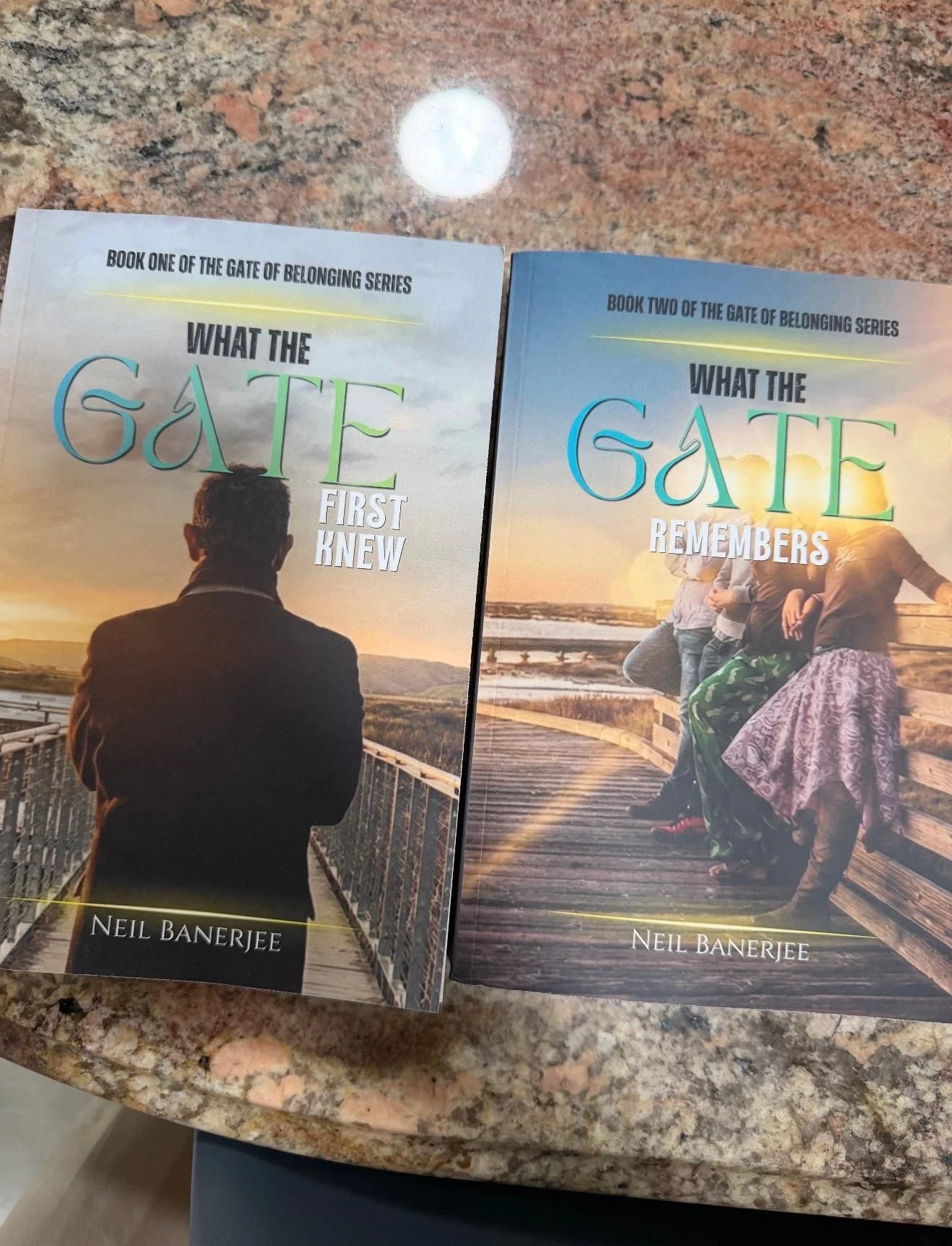
Novels are available from all relevant stores online
Make it yours!
Putting these together made me notice something.
I thought I had written two books about belonging.
Maybe I did.
But there are an awful lot of lines here about paying attention.
To houses. To cities. To parents. To children. To the things people make with their hands. To the ordinary things someone does for us so often that we stop noticing they’re acts of love.
Maybe belonging begins there.
Or maybe that’s simply what I happen to see in these lines because I’m the person who wrote them.
You may see something completely different.
I’d actually prefer that.
So take whichever line stopped you for a second.
Use it somewhere. Send it somewhere. Let it mean whatever it means to you.
Just don’t be surprised if I smile when I come across it someday and think:
I know that sentence.
Check more about my books by visiting www.nban.io/books
This post was originally published on Aug 19, 2026 on sub-stack https://neilbanerjee.substack.com/p/47-lines-im-letting-leave-the-books